Aug 11, 2022

Seeing Stones


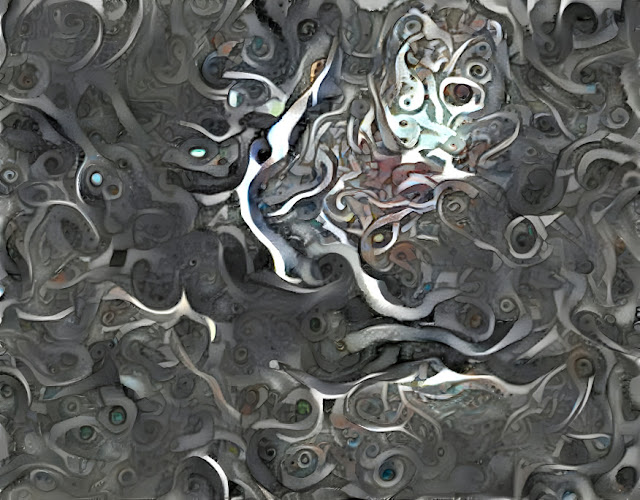
   You're staring at the evolution of my digital art, and it's staring right back at you.   I can make this assertion with a certain degree of confidence (considering the style templates I designed to be used in my deep dream generated pieces).  The swirling patterns that result often generate eye-like whirlpools in their random interwoven configurations for a reason.   

        A few months ago I began working on a series of digital images rendered using Wombo (since they added the feature of being able to upload images for transfiguration).  I was working on the idea of creating a gallery of images which would be presented in the form of individual cards in an oracle deck.  I had already begun to build several oracle decks, beginning with the Tolkien middle-Earth deck (which for now I've been referring to as my Ennor deck), continuing with a series of individual cards based on Werewolves which I call the Wolf Pack, a Melnibonean oracle deck, and a Kaiju deck which features a subcategory (which is to say, many guest star appearances) depicting nods to Ultraman.  

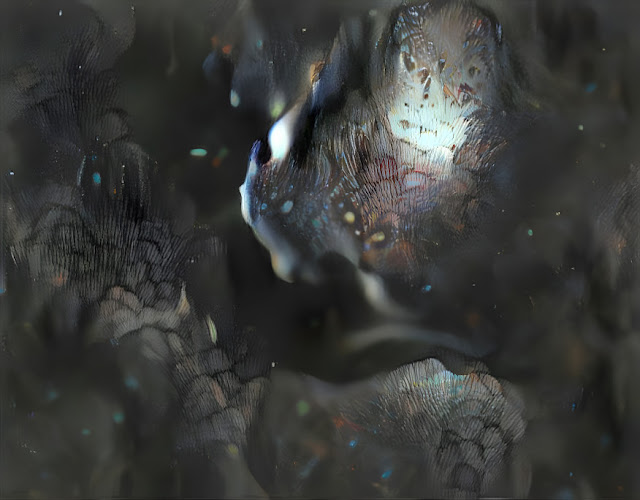
   The Seeing Stone  deck is comprised of a series of images which all feature the oval shape of the cabochon-cut stones that I bought from my friend Andy through his Etsy shop Uncommon Stones. It all started the day I asked him to shine a blacklight on one of his dinosaur bone stones. A vivid interlaced tapestry of fossilized veins shone out in the resulting picture I took of it on my cellphone.  I decided to use this as a style template in Deep Dream Generator as well as in Wombo.  The two images depicted below were created on the Wombo app.  


   These two cards are from my dinosaur oracle deck.  The idea being, it's the same stone, only each time you look into it, a different scene from the distant past is shown.  In the case of this stone, it always displays glimpses into eras back when the dinosaurs roamed. These 'time stones' are kind of like little palantirs, which is to say windows through which the viewer may see certain scenes of the past.  

    The crux of the matter lies in the stones themselves, in particular the one dinosaur fossil which I photographed under blacklight. That's the one I think of as my flux capacitor. It's ultra hi-lit profile, based on an actual fossil record, serves as the foundation upon which the AI text-prompted vectors were configured into their shapes.  (It's sort of an exercise in showcasing a range of possible variants to the requested scenery, and the best of these may serve to represent that bygone possibility, a subject still available for examination in hindsight.)    

      As noted in the image at the top of the page here, the middle stone appears to be staring up at the top stone.  A closer examination of the top stone reveals embryonic, curled configurations within it enough for different people seeing it to notice different patterns, such as can be discerned in a Rorschach test. This stone may appear far older than the smaller one below it, which by contrast in its size, possibly resembles more of a newborn stone, or at least one yet in its infancy.  These two are the opals. 

    The two darker stones below are the dinosaur fossils.  The one to the right appears to have an eye with which it stares out of and off the page at an angle.  The stone to the left seems to be a tangle of shadows and tails or some sort of blended components nestled up within the stone. The impression I'm left with is that these four altogether appear to be some sort of family of stones forming a nuclear unit, conjuring an electromagnetic connection, like lodestones.  

   The seeing stones (as I have devised them) signify that time travel, as we have typically come to hope or expect it to be (i.e, the ability to actually travel into the past or future), remains a mere fantasy; an objective which, if applied here in the real world, will quite likely never yield those desired results.   Thus making this ability of the seeing stones to only permit us a  'glimpse' of certain sections of the past a much more viable alternative to the sort of outright time-travel found in fantastic fiction.  In other words, the idea behind my seeing stones remains focused on what the next-best thing to "so-called actual time-travel" would be, so to speak.    


Feb 8, 2022

The Origins of Image

      photography + digital artwork by Shaun Lawton 


    The image above, to me, seems to represent perhaps some old, weathered piping deep underground, polished over time by running water beneath the topsoil, of what's left of some ancient ruins stemming from a subterranean Dwarven fortress.   Perhaps it's the locking mechanism from an ancient gateway that once separated the cavernous realm of Khazad-dûm from the rest of middle-Earth.   Or maybe it's the remains of an old carburetor or the twisted wreckage of an ancient Aztec sculpture; it's difficult to pinpoint, exactly.   

   Now that we're more thoroughly nested within the continuum referred to as "the 21st century," with its deep fake images receding into the darkest corners of a world wide web having taken on a life of its own, we are at least mentally equipped enough that we might recognize such an image as being itself fabricated from any variety of source images, rendering the final form of it in some manner to be counterfeit.  Yet is not that the very precinct of art itself?  If we assume that the word art may serve as the prefix for artifice and everything "artificial," then yes, but when we lean back and relax on the thought that beautiful artworks, from abstract sculptures carved out of marble to vivid paintings which reflect, through light itself, startling images to our eyes, we do get a sense of the inherent value of such a contrivance.   The images shown here should hardly be thought of as counterfeit, considering there remains no real precedent to which they stay attached, at least not one which could effectively substitute them.  

    From a a teaspoon of spilled water on a stone countertop to the above image, I've been left here to trace the random lineage of appearance and its endless forms of similitude.  Right off the bat I should introduce the above image as having resulted from my uploading a source image  (the photograph I snapped of our friend's kitchen counter top with some water spilled on it you see at the very bottom of this post) into an online free photo editor  (befunky, my random choice of freely available and easy to use photo editors) and messing with the brightness / contrast / colors until achieving a darker and more interesting look.  Then I uploaded that resulting image  (a .jpg . . . do I look like I know what a .jpg is) into Deep Dream Generator and after pairing it with a separate image and making some minor adjustments, the image morphed into several different forms (see two of them below), made possible by my switching out some of the "style" images in DDG for experimentation, until it resulted in the top three iterations you see posted here.   


     Why are these iterations so alluring and interesting looking?  My guess is that the source image must've been rich with visual cues and elements which lend themselves in highly adaptable ways to the VQGAN + CLIP programs that enable AI algorithms to generate random iterations of two separate images fused together like this.  There must be a plethora of scintillating color cues embedded within the light captured in the original photo reflecting off the polished stone table top and off the curved surface of the water spill itself to produce a myriad different combinations of results, ensuing in a multiplicity of possible iterations when you consider that there's no limit to the second "style image" you might choose to utilize in crafting your deep dream generative artworks.  


    I love this one a lot, something about the textures evoke not just obsidian but some sea-shell like aspects, as if it were at the bottom of a deep river or some reflections off volcanic glass in a rainforest lagoon.  These evocative hues and patterns which can be elicited from tweaking certain source images taken with a smartphone and then ran through a basic online photo editor before being paired with stylistic images to generate countless disparate iterations will continue to keep me inspired on my new mission to conjure Rorschachian portraits which reflect a cornucopia of pareidolia-enhanced visual representations that I would very much like to frame and call "art."   


  Here's the original source image, the snapshot taken from my iPhone of a kitchen table top, with some water spilled on it.  I remember focusing on the water spill from a certain angle in order to capture the light from the ceiling reflecting off the water itself to the point it resembled a dragon's head.  Pleased with the results, little did I know then that this singular image would evolve into the even more interesting and mystifying images depicted above, resulting from my introduction to the world of VQGAN + CLIP art.  The secret which makes this particular mundane photo so effective at having been decoded and rearranged, I would guess, lies in the very fact that it depicts  water  atop a bright, reflective counter top  with the added bonus of having light reflected off both the water and the polished stone surface.  

Jan 31, 2022

From Rat Fink to I’dchii K’riccian

 
Winged order of angels hold court

   Several years ago one of the cracked mirror reflections of a mysterious minister of slack known in certain spiral corridors as Cardinal Sin came up with a list of story titles and announced to his virtual online classroom that we could pick a title and then write a story about it. There were at least thirty titles to choose from, and the one I liked the most was Speed Demon.  

   It just had this ring to it.  In my mind one of the first things it conjured was Rat Fink in his hot rod going God knows how many mph with his great big slimy tongue lolling out of his mouth. I almost immediately thought of it as a tattoo, for some odd reason. Most of the titles in the list the Cardinal came up with had something to do with high velocities. FTL was one of them. So was Survivor's Guilt. 

   The story formed itself in layers working their way out from some of these core concepts. I thought of a guy who loved to skateboard as a teen but now works as a service engineer in a future where travelling hundreds of miles in a short time has been enabled by antigravity jumpsuits. And not much else has changed, except that the main character likes to drop up into the sky on nights when the Aurora Borealis is out in plain sight. He aims to launch high above it to see if it's still visible from that angle. Maybe it'll disappear like a rainbow around the bend. 

   I wanna make my hero a likeable guy and everything, so I settle on naming him Jud Roth, after the Big Daddy himself, Ed Roth who created the Rat Fink character as a sort of nemesis to Mickey Mouse. So anyhow, Jud's older now so he doesn't really skate anymore, but at least he's jumping into the mesosphere for a lazy dip before dropping back down.  Sure he used to be the fastest back in the day when he was a kid. And now he's about to break the all time world wide human speed record. 


   This image was prompted by AI algorithms and the words "man in power suit falling through spinning vortex in space" with the key words "gravitational lensing" tossed in, for good measure. 
Now if that don't look like a dog in some tracksuit skateboarding out of some graffiti vortex or funhouse of mirrors, I don't know how but that's a dude on a skateboard. Never mind that my character (Jud)  used to love trick skating or what not, He’d sprung for a tattoo of a Rat Fink Comix style skate punk, with red veined eyes bugging out of his head and drooling tongue lolling out of his mouth, wearing spiked leather pants while riding a skateboard into a spinning vortex. He had it inked right between his shoulder blades. 

   So even though I didn't go with this image for my story, I've put it up as the Freezine banner art for the moment, as well as here showcased on Eyeseat.  I think what I'll do is rather than keep one fixed image to represent Eyeseat, I'll just keep switching out the Banner Art and put it instead of title and description so that it shows up on mobile devices automatically.  So I figured Jud would have a counterpart on a neighboring exoplanet, which is where our man I'dchii K'riccian steps in, with his nine foot long wings and his blood ancestry to some angels which Gurdjieff wrote about. 

   The way the tall and slender Birdmen of Kiriick became, in a sense, the true protagonists of my story may just go to show how I've constructed some of my sand castles from a sense of inversion. Focusing on the electromagnetic aspects of the story and the fact that birds experience magnetoception made writing Speed Demon a real challenge for me. How would I fulfill it's silent plea to deliver unbelievable speed, and what's so demonic about it anyhow?  Little did I know at the outset how much resonant irony would fall into place beneath the shadow of the title.  


     Here is yet another iteration having used the exact same sequence of text prompts I used for the last image. I've really come to associate this one with Jud's Fall even more, as a sort of abstract realtime rendering, if you will. He's twisting over falling fast, perhaps only captured in bodily blur by a lightning quick shutterbug camera, but whatever the case may be, I cropped the above section and adjusted its brightness and shadows along with some other minor modifications to the color, temperature and hue.

   This has been an impromptu recapitulation of a singular aspect about my story Speed Demon. I leave it here to rest in Eyeseat for posterity.  


Jan 30, 2022

Entering a New Medium: the Oracle Deck

 by Shaun Lawton


                           This image was conjured from nothing but my own chosen words

I've made a turn from analog to digital methods insofar as the materials I use for my illustrations, having once been more often represented by watercolors and magic markers left to be absorbed by white blank glossy photographic paper, I'm now enjoying a degree of creativity seldom imagined by having been introduced to the world of VQGAN + CLIP art (being generated in countless iterations by virtue of AI-assisted algorithms reconfiguring text prompts and source images pixel by pixel into any variety of what might seem to be preprogrammed structures, but more or less stand as randomly-generated abstractions whose forms are interpenetrated by the subtle use of text-harmonics, buried as deeply steeped as the poet behind the wheel cares to steer his or her mind-car into the wild and abandoned field of retrospective analysis of the stored files of human consciousness) and I'm enjoying the readily available new and easy-to-use apps such as Wombo Dream, now appearing on smartphone screens everywhere.  

   The image above (in hues of green against a crimson backdrop) is a detail cropped from a larger image that I generated using the Wombo Dream app on my iPhone. I messed with the exposure (reducing the brightness by around twenty percent, heightening the contrast and shadows respectively, and reducing the highlights), then I altered the hue by one-hundred-and-eighty degrees. I think I dialed the saturation and temperature down and back up until I had that lovely shade of blood red within the interstices of the green networking that appears to issue from the figure like stylized rags of a cape. His head appears within a clear bubble helm or force field; a sort of astronaut presumably in his element. The original image I've referred to as "Jud's Fall," in reference to the character in my story Speed Demon, now published by the Freezine of Fantasy and Science Fiction (in issue # 31).    

   Applying the principles which control the outcome of text-to-image software prompting into exciting and unique ways has led me to begin building various decks and packs of cards with AI-assisted imagery on them into either one grand multiverse deck or perhaps various interesting oracle packs.  (I was led to think of this from the Wombo Dream app, which formats the images into the shape of cards.)  Below is one which resulted from the following text prompt: "Man falls through outer space electromagnetic toward another planet." (Some of my Wombo Dream cards I keep the word prompts, because they are autosaved as 'dream' by the system.)   This one came out rather unique since you can make out a face somewhat grossly distorted behind the translucent space helmet bubble they appear to be wearing.  


I'm happy with how this image resulted, especially since the garish hues selected by whichever style on the Wombo app I used can easily enough be manipulated or toned down or otherwise altered, and considering one may utilize any number of websites or apps to further distort the source image, you're looking at a pretty happy online graphic artist, here.  So I went ahead and ran this one through Deep Dream Generator, and here are the somewhat fly-by-the-seat-of-my-pants results generated with my initial attempt: 


I chose the "Carina Panorama" template from Deep Dream Generator (for reasons which serve to highlight the scene in my story) and the results fall more or less within the parameters of my vision's range (although I'm not 100% satisfied, it'll do for now). The scope of this processing even seems to have affected the character wearing the space helm. There's definitely a more pronounced "space cadet" look to it, almost reflecting a sort of homage to the "it's full of stars" meme from the 2001 film sequel.  Of course I'm using it for my story, at least for now. I can't believe how it all came together and ended up turning out.  And since I've already generated well over one hundred different oracle cards using the Wombo Dream app, I've got more than enough work on my hands coming up sorting them all out into their respective decks and packs.  Two of my early favorites are the Shape Shifters Pack and the Kaiju Battle Deck.  Collect them all and begin divining the future of your fantasy life...