Dec 2, 2022

The Last of the Thrones of Pele

written & illustrated by Shaun Lawton 


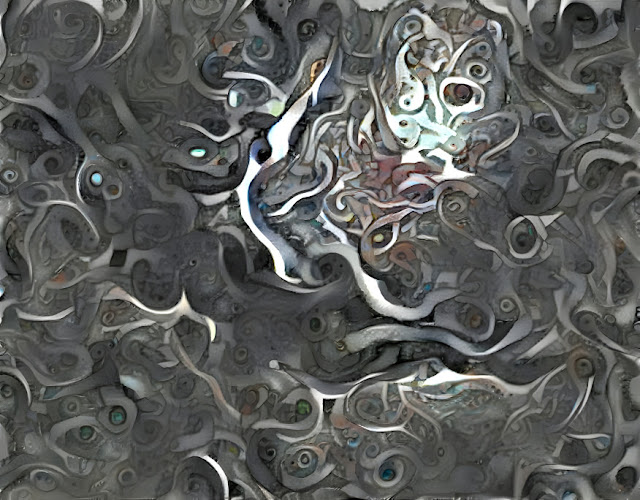
    The text prompt I used in the Outpainting of the golden image of the upside down throne depicted here was "the throne of life cradling an oasis of water in an electrically charged atmosphere," but then after a few quadrants had extended the panoramic display both up, down and across, I carefully selected one of the four variants offered for each successive part of the expanding puzzle, and then I added "in flowing plasma" for the final, bottom portion of the strange canvas you see I have tried my best to  digitally paint using a variety of AI tool methods.  (Without my Griffin Mandala template, the wriggling, wormlike details of tendrils entangled in the murky darkness in between those interstices of light would never have manifested.) There's a lot going on in the above composition, which leads me to ponder over whether I should perhaps continue Outpainting from this expanded image in all four directions, making it larger and more fascinating, at the risk of potentially deteriorating it's allure or mystique into more senseless abstraction.   

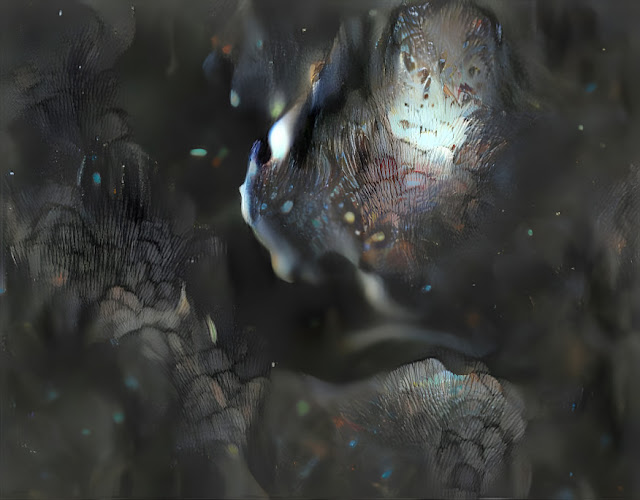
    Yet in that direction lies another reason to ponder over the development of this image. The core of it is a closeup of an IKEA lamp I took a snapshot of in my kid's bedroom one night. From this digital photograph I extrapolated variant images after running it through various AI filters and tools, primarily Deep Dream Generator and DALL*E.    This may not be considered great art atm but I think it looks great and I'll be damned if I'm going to stop exploring with the array of digital tools at my disposal, on account of how wildly focused I am on seeing what can be dredged up from the depths of our most obscure collective consciousness. 

   I'm having the time of my life here and now with this hobby and I'm looking forward to where the rapidly advancing software takes us next. I've already set this image as my PC wallpaper and the details I'm catching in just the lower section alone are quite interesting enough to keep my attention pretty riveted tbh.  One thing to point out is how I haven't even bothered to upscale this image, but that comes from a strictly artistic decision on my behalf.  I prefer some of the initial variants and their more primitive renderings over the well synthesized and homogenous efforts from AI's hybrid upscaling effect.  

   If I can avoid that it will leave me with a gallery of images operating on a threshold just below that popular waterline. A layer lurking just underneath the surface. I'm as bored with the majority of over familiarized, glossy super hi-resolution digital art being passed around as the next plugged-in websurfer; an art form legitimately admired by scores for its sophistication alone.  Obviously I'm choosing another path given the same tools at our disposal, the whole wide world seething around us in all its variform menu of routes and options. 

    Looking at the whole thing here, the resultant image at the top of this article, it's pretty much a head trip, on an individual and global level.  I'm left speechless in admiration for the strange terrain the AI algorithms helped me map out, or I mean it the other way around, it was I who helped the AI to shape the fantastical configurations of this fictional landscape of the mind. A newly formed territory taking shape as if it were its own rapidly developing exoplanet. 

   Captured in these twisted formations fleeting faces can be glimpsed, profiles with eyes staring out from their trapped position, along with the serpentine volcanic pillar configurations with one in particular who's features seem etched into a totemic smirk, in some way an emissary of Pele; in a setting with a sense of a terrific force exploding in a maelstrom of creationism across the raw elements of magma, water and land. There's a sense of the apocalyptic in an elemental way with this painting, and there are still new creatures manifest from the pareidolia inherent to the composition. 

   The explosive suggestiveness captured in this vivid imagery of titanic forces at work in nature should at least hold some weary passers-by interest for a spell.  I'd wager that meets the objectives of art. Oh, well.  At least it's keeping me happy and occupied. These bewitching abstract images lure my imagination into writing down descriptions of them into characters and settings, while keeping one thing in the singular forefront of my mind: words forming text prompts shaped the images which feed back into fueling the setting and characters in my stories which will always be told in words.  


Oct 16, 2022

Polydimensional Outpainting

by Shaun Lawton 

Polyphelia


    I like to create a sort of polydimensional art. Painting with light in the digital medium. 
Electromagnetic resonance helps guide the outcomes. Think of it this way. 
It's how everything works. We're swimming in time. The art of cutting through it
becomes very difficult to master, in the manner which has the least effect on temporal 
turbulence.    

   The top center square in the above composite is "The Unremembered," or the seed square from which the adjacent squares were generated (with a little extra guidance from my tailored text prompt 'Artificial human avatars awash in a sea of digital information, panoramic high definition, mirror chrome armor, future holo ads'. 

   The resulting Blade Runneresque imagery is interesting in its strobe layered effect and the morphing of the anatomic figure to the left, herself an intriguing new identity in the spectrum of femme bots, mannequins, androids or whatever they might represent. 

   Polyphelia.   That's the name of this digital outpainting of The Unremembered.  
 

Oct 8, 2022

Pretty October


  I find the story behind how I came to achieve these results (seen in the digital painting I did above) to be of interest, at least to myself and perhaps a few oddly like-minded individuals who have come to appreciate some of the finer aspects of the AI-assisted digital art revolution currently exploding in the midst of a tsunami of paradigm-shifting changes taking affect this moment the whole wide world over.    

     Eight years ago, during early August 
I posted a poem on my TWILIT blog called Pretty.   


PRETTY


I secure a darkest vision
I hold its hand as it walks down
The cellar stairs lack precision
In the dark there hides a clown
It is smiling very loudly
For look what it has found


   I wanted to try an experiment converting text prompts into random digital images super-intricately wrought by AI algorithms, so I copy pasted the six lines of this poem, word for word, into DALL*E and clicked generate.


   (Nevermind the fact that I'd already considered that this poem could also be titled Pennywise, I prefer my own original title anyhow, for various reasons, not the least of which is that one of my mentors, St. Giraud, may his anima rest in pax, already beat me to the Punch by having written a poem under that moniker, and besides I ran it as a variant in one of my blogs once, and I don't think anyone really noticed.)


   The 4 variants that DALL*E assembled and presented to me, which is to say the first series of iterations of their literal interpretations of the significance of those six lines of poesy, yielded three right up front that were preposterous in not only their garish aspect, but in how far from my hoped-for expectations these results actually strayed. That is, except for the 4th variant, which despite also not even coming anywhere near the spirit of intention behind my lines of verse, at the very least uncannily resembled the female countenance of an ordinary person in a setting presumably to be construed as necessarily being down in the basement, albeit that of a maximum penitentiary.


   "This one will do," I thought to myself as I dl'd the raw image to my hd. From there, I uploaded it to my Deep Dream Generator account, and there I ran it through my universal colorizer template with the standard settings weighted at their 50% default. The glorious results you see depicted at the very top of this article, I decided to title "October," in a nod to the current month, but also because something indefinable whispered for me to do it. Even as I can see the connotations implicit between the final image and the new title, something inside me is now adding to the harmonious refrain, the suggestion that it not only retain the original title, Pretty, but I now am being forced to consider that this final creepy rendering of the image which was rendered from my poem may have strangely presented itself as the ideal illustration for it, after all.  

    Idk.   What do you think?  (Of the 3 followers  that appear to have remained, I don't even know if Austin Pray is getting this in his inbox, or what.  That's okay...I've long become accustomed to the fact that my blogging for all these years is largely to a gallery of ghosts...).  . .  


Aug 11, 2022

Seeing Stones


   You're staring at the evolution of my digital art, and it's staring right back at you.   I can make this assertion with a certain degree of confidence (considering the style templates I designed to be used in my deep dream generated pieces).  The swirling patterns that result often generate eye-like whirlpools in their random interwoven configurations for a reason.   

        A few months ago I began working on a series of digital images rendered using Wombo (since they added the feature of being able to upload images for transfiguration).  I was working on the idea of creating a gallery of images which would be presented in the form of individual cards in an oracle deck.  I had already begun to build several oracle decks, beginning with the Tolkien middle-Earth deck (which for now I've been referring to as my Ennor deck), continuing with a series of individual cards based on Werewolves which I call the Wolf Pack, a Melnibonean oracle deck, and a Kaiju deck which features a subcategory (which is to say, many guest star appearances) depicting nods to Ultraman.  

   The Seeing Stone  deck is comprised of a series of images which all feature the oval shape of the cabochon-cut stones that I bought from my friend Andy through his Etsy shop Uncommon Stones. It all started the day I asked him to shine a blacklight on one of his dinosaur bone stones. A vivid interlaced tapestry of fossilized veins shone out in the resulting picture I took of it on my cellphone.  I decided to use this as a style template in Deep Dream Generator as well as in Wombo.  The two images depicted below were created on the Wombo app.  


   These two cards are from my dinosaur oracle deck.  The idea being, it's the same stone, only each time you look into it, a different scene from the distant past is shown.  In the case of this stone, it always displays glimpses into eras back when the dinosaurs roamed. These 'time stones' are kind of like little palantirs, which is to say windows through which the viewer may see certain scenes of the past.  

    The crux of the matter lies in the stones themselves, in particular the one dinosaur fossil which I photographed under blacklight. That's the one I think of as my flux capacitor. It's ultra hi-lit profile, based on an actual fossil record, serves as the foundation upon which the AI text-prompted vectors were configured into their shapes.  (It's sort of an exercise in showcasing a range of possible variants to the requested scenery, and the best of these may serve to represent that bygone possibility, a subject still available for examination in hindsight.)    

      As noted in the image at the top of the page here, the middle stone appears to be staring up at the top stone.  A closer examination of the top stone reveals embryonic, curled configurations within it enough for different people seeing it to notice different patterns, such as can be discerned in a Rorschach test. This stone may appear far older than the smaller one below it, which by contrast in its size, possibly resembles more of a newborn stone, or at least one yet in its infancy.  These two are the opals. 

    The two darker stones below are the dinosaur fossils.  The one to the right appears to have an eye with which it stares out of and off the page at an angle.  The stone to the left seems to be a tangle of shadows and tails or some sort of blended components nestled up within the stone. The impression I'm left with is that these four altogether appear to be some sort of family of stones forming a nuclear unit, conjuring an electromagnetic connection, like lodestones.  

   The seeing stones (as I have devised them) signify that time travel, as we have typically come to hope or expect it to be (i.e, the ability to actually travel into the past or future), remains a mere fantasy; an objective which, if applied here in the real world, will quite likely never yield those desired results.   Thus making this ability of the seeing stones to only permit us a  'glimpse' of certain sections of the past a much more viable alternative to the sort of outright time-travel found in fantastic fiction.  In other words, the idea behind my seeing stones remains focused on what the next-best thing to "so-called actual time-travel" would be, so to speak.    


Feb 8, 2022

The Origins of Image

      photography + digital artwork by Shaun Lawton 


    The image above, to me, seems to represent perhaps some old, weathered piping deep underground, polished over time by running water beneath the topsoil, of what's left of some ancient ruins stemming from a subterranean Dwarven fortress.   Perhaps it's the locking mechanism from an ancient gateway that once separated the cavernous realm of Khazad-dûm from the rest of middle-Earth.   Or maybe it's the remains of an old carburetor or the twisted wreckage of an ancient Aztec sculpture; it's difficult to pinpoint, exactly.   

   Now that we're more thoroughly nested within the continuum referred to as "the 21st century," with its deep fake images receding into the darkest corners of a world wide web having taken on a life of its own, we are at least mentally equipped enough that we might recognize such an image as being itself fabricated from any variety of source images, rendering the final form of it in some manner to be counterfeit.  Yet is not that the very precinct of art itself?  If we assume that the word art may serve as the prefix for artifice and everything "artificial," then yes, but when we lean back and relax on the thought that beautiful artworks, from abstract sculptures carved out of marble to vivid paintings which reflect, through light itself, startling images to our eyes, we do get a sense of the inherent value of such a contrivance.   The images shown here should hardly be thought of as counterfeit, considering there remains no real precedent to which they stay attached, at least not one which could effectively substitute them.  

    From a a teaspoon of spilled water on a stone countertop to the above image, I've been left here to trace the random lineage of appearance and its endless forms of similitude.  Right off the bat I should introduce the above image as having resulted from my uploading a source image  (the photograph I snapped of our friend's kitchen counter top with some water spilled on it you see at the very bottom of this post) into an online free photo editor  (befunky, my random choice of freely available and easy to use photo editors) and messing with the brightness / contrast / colors until achieving a darker and more interesting look.  Then I uploaded that resulting image  (a .jpg . . . do I look like I know what a .jpg is) into Deep Dream Generator and after pairing it with a separate image and making some minor adjustments, the image morphed into several different forms (see two of them below), made possible by my switching out some of the "style" images in DDG for experimentation, until it resulted in the top three iterations you see posted here.   


     Why are these iterations so alluring and interesting looking?  My guess is that the source image must've been rich with visual cues and elements which lend themselves in highly adaptable ways to the VQGAN + CLIP programs that enable AI algorithms to generate random iterations of two separate images fused together like this.  There must be a plethora of scintillating color cues embedded within the light captured in the original photo reflecting off the polished stone table top and off the curved surface of the water spill itself to produce a myriad different combinations of results, ensuing in a multiplicity of possible iterations when you consider that there's no limit to the second "style image" you might choose to utilize in crafting your deep dream generative artworks.  


    I love this one a lot, something about the textures evoke not just obsidian but some sea-shell like aspects, as if it were at the bottom of a deep river or some reflections off volcanic glass in a rainforest lagoon.  These evocative hues and patterns which can be elicited from tweaking certain source images taken with a smartphone and then ran through a basic online photo editor before being paired with stylistic images to generate countless disparate iterations will continue to keep me inspired on my new mission to conjure Rorschachian portraits which reflect a cornucopia of pareidolia-enhanced visual representations that I would very much like to frame and call "art."   


  Here's the original source image, the snapshot taken from my iPhone of a kitchen table top, with some water spilled on it.  I remember focusing on the water spill from a certain angle in order to capture the light from the ceiling reflecting off the water itself to the point it resembled a dragon's head.  Pleased with the results, little did I know then that this singular image would evolve into the even more interesting and mystifying images depicted above, resulting from my introduction to the world of VQGAN + CLIP art.  The secret which makes this particular mundane photo so effective at having been decoded and rearranged, I would guess, lies in the very fact that it depicts  water  atop a bright, reflective counter top  with the added bonus of having light reflected off both the water and the polished stone surface.